The Cabo Rounded Family: A Designer’s Personal Journey That Became a Typeface
There is something deeply satisfying about a typeface that begins not as a commercial project, but as a personal experiment. The Cabo Rounded Family is exactly that—a font collection born from one designer’s desire to refresh their own visual identity. What started as a simple logo revision in Adobe Illustrator turned into something far more substantial: a complete, multi-weight rounded sans-serif family that now offers designers an unexpectedly versatile tool for everything from branding to editorial layouts. The story behind it feels almost accidental, but the result is anything but.
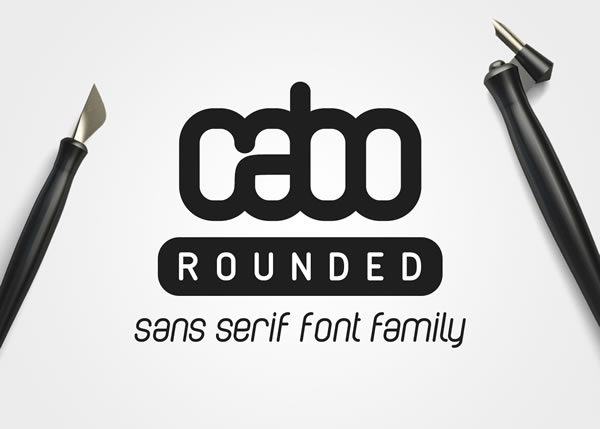
The origin of the Cabo Rounded Family traces back to a moment many creatives will recognize. The designer, operating under the studio name cabo, had been using a logo built on Helvetica since 2013. It worked. It was clean, reliable, and professional. But over time, that initial satisfaction faded into the quiet itch for something more personal, more distinctive. Last year, that itch finally led to action. Instead of simply tweaking the old mark, they opened Illustrator and began exploring shapes and strokes from scratch—rebuilding the logo around a custom letterform that felt both familiar and fresh.
What makes this origin story worth telling is what happened next. While perfecting the characters for the new logo, the designer recognized that the emerging style had potential beyond a single wordmark. The rounded terminals, the friendly proportions, the consistent stroke modulation—these qualities formed a coherent visual language that could easily scale into a full character set. Within hours, the first drafts of what would become the Cabo Rounded Family were ready. The jump from personal project to typeface design was rapid, driven by genuine excitement rather than a calculated business decision.
Understanding the Structure of the Cabo Rounded Family
One of the first things you notice about the Cabo Rounded Family is how thoroughly it has been built out. This is not a single font with a couple of weights tacked on as an afterthought. The family includes ten distinct fonts: five weights, each with a matching italic version. You get Cabo Rounded Regular and Cabo Rounded Italic, Cabo Rounded Bold and Cabo Rounded Bold Italic, Cabo Rounded Light and Cabo Rounded Light Italic, Cabo Rounded Medium and Cabo Rounded Medium Italic, and Cabo Rounded Thin along with Cabo Rounded Thin Italic. That kind of breadth immediately signals that this typeface was designed with serious use in mind.
The range from Thin to Bold gives designers genuine flexibility. Thin weights work beautifully for large, airy headlines where you want the letterforms to feel delicate but still readable. At the other end, Bold handles short display text, buttons, and emphasis with confidence. The Medium sits in a sweet spot for body copy in digital interfaces, while Light offers a subtle alternative for captions or secondary text. Because every weight has a true italic counterpart—not just an oblique slanted version—the family maintains consistency across typographic hierarchies. Italics in the Cabo Rounded Family carry their own rhythm, slightly more calligraphic in feel, which adds texture to longer reading experiences.
For designers who work across media, this kind of depth matters. You can set a magazine spread using Light for the body, Regular for subheadings, Bold for pull quotes, and Thin for the folio numbers, and the whole page will feel cohesive rather than cobbled together from different fonts. The Cabo Rounded Family eliminates the need to mix rounded sans from different sources, which often leads to mismatched x-heights or incompatible stroke weights.
Why Rounded Sans Serifs Work in Modern Design
Rounded sans serif typefaces have experienced a steady rise in popularity over the last decade, and for good reason. Softened corners and open apertures make them inherently approachable without sacrificing legibility. The Cabo Rounded Family leans into this quality. Its rounded terminals are not exaggerated to the point of becoming novelty; they are subtle enough that the typeface remains serious and usable in professional contexts, yet present enough to give text a warm, human feel.
This balance is harder to achieve than it sounds. Many rounded fonts tip too far into playful territory, making them inappropriate for corporate communications or long-form reading. Others round their corners so minimally that the effect is barely noticeable, defeating the purpose entirely. The Cabo Rounded Family manages to sit in a useful middle ground. It carries the friendliness of a rounded sans but retains the structural discipline of a well-drawn geometric typeface. This makes it suitable for a surprising range of applications.
Consider a fintech app interface. You want clarity and trust, but also approachability. The Cabo Rounded Family’s Light or Regular weight in UI labels and buttons can soften the coldness often associated with financial tools. For a children’s book publisher, Bold and Medium weights bring warmth to chapter headings while remaining perfectly readable at smaller sizes. Even in corporate branding, where Helvetica and its cousins have long dominated, the Cabo Rounded Family offers a way to differentiate without resorting to eccentricity.
Practical Workflow Integration and Use Cases
When you adopt a typeface family like this one, the practical question is always: how easily does it fit into existing workflows? Because the Cabo Rounded Family was born from a designer’s own project, it carries an intuitive understanding of how real creatives work. The font files are well-hinted and kerned, meaning they render cleanly on screens without excessive manual adjustment. The italic versions are genuine italics, which means they behave correctly in layout software like InDesign, Figma, or Sketch without requiring style overrides.
For web designers, the Cabo Rounded Family performs well across operating systems. The rounded forms do not break down at small sizes, and the consistent stroke contrast ensures that thin weights remain readable even on lower-resolution displays. If you are building a brand system that needs to scale from a mobile app to a billboard, having all ten styles available means you can define precise typographic rules without resorting to fallback fonts that dilute the identity.
I have found that the Medium weight is particularly effective for data visualizations. Labels on charts, legends, and axis titles benefit from the slight softness that makes numbers and short labels feel less clinical. The Bold Italic works well for emphasis in sidebar callouts, while Light Italic can handle lengthy captions without overwhelming the layout. In editorial design, the weight range allows for real typographic architecture—you can build contrast through weight shifting alone, without changing typefaces between headings and body copy.
What to Consider Before Choosing the Cabo Rounded Family
No typeface is right for every job, and the Cabo Rounded Family is no exception. Its rounded character, while versatile, leans toward a softer tone. If your project demands stark neutrality or extreme formality, a traditional grotesque might serve you better. Similarly, the family’s geometric underpinnings mean it pairs best with typefaces that have contrasting proportions—a transitional serif for long-form reading, for instance, or a monospace for code snippets. Using it exclusively for everything can make a layout feel too uniform, so consider it as part of a larger typographic palette rather than a one-size-fits-all solution.
Licensing is another factor. The Cabo Rounded Family is a professionally crafted typeface, so it is not free. For independent designers and small studios, the cost is justified by the breadth of weights and the quality of the italics, but it is worth evaluating whether you genuinely need all ten styles. Many projects can function with just Regular, Bold, and their italics. The Light and Thin weights, while beautiful, are specialized tools that may not see frequent use depending on your work.
Also consider file format compatibility. Most modern font distribution services provide OTF, TTF, and WOFF variants, but if you work in niche software or legacy systems, verify that the Cabo Rounded Family supports your workflow before committing. The designer’s background in logo and identity work suggests a strong attention to technical detail, but it is always prudent to test a typeface in your actual production environment.
Observations from Working with the Family
Having used the Cabo Rounded Family across several projects—ranging from a tech startup’s brand guidelines to a short-run printed zine—I can offer a few grounded observations. The spacing is generous without being loose, which makes body text comfortable to read even at smaller point sizes. The italics deserve special praise: they are not merely slanted versions of the upright forms but feature subtly different letter shapes that give them their own voice. This is rare in rounded sans families, where italics are often an afterthought.
The Bold weight in particular has a presence that works well for headlines in both print and digital contexts. It carries enough weight to command attention but avoids the heavy, cluttered feel that some bold rounded fonts develop when the curves become too thick. The Thin weight, meanwhile, requires careful handling—it is lovely at large sizes for titles or hero text, but at small sizes on screens it can lose definition if the display resolution is low.
One unexpected use case I observed was in wayfinding signage mockups. The rounded forms, especially in Medium and Regular, read clearly from a distance and feel inviting rather than institutional. This suggests potential applications beyond the screen and page, into environmental graphics and exhibition design.
The Cabo Rounded Family in Broader Design Context
The typeface landscape is crowded. New families appear regularly, and many fade quickly because they lack a clear point of view. The Cabo Rounded Family stands out because it carries the DNA of a real designer’s creative process—the tension between personal expression and functional rigor. It is not trying to reinvent typography. Instead, it offers a well-executed, thoroughly weighted rounded sans that answers a genuine need: a single family that can handle both friendly branding and serious editorial work without compromising on either.
For designers who value authenticity in the tools they use, knowing that this typeface began as a logo refresh for a real studio adds a layer of meaning. It was tested in the wild before it was ever packaged for sale. The weights were born from practical need, not market speculation. That origin story shows in the final product. The Cabo Rounded Family feels intentional. It feels used. And for anyone building a visual identity that needs to communicate clarity with warmth, it deserves a close look.
Whether you are refreshing your own logo, designing an interface, or laying out a publication, the Cabo Rounded Family gives you the range to move confidently across formats. From Thin to Bold, from upright to italic, each style holds its own while belonging to a coherent whole. That is rare. That is worth considering. And it all started with a designer who simply wanted a better logo.