Sonten Typeface: Serif Design with Depth and Versatility
What Exactly Is the Sonten Typeface?
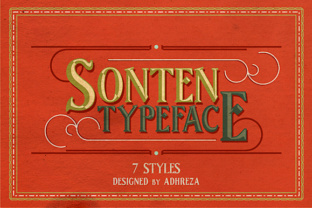
The Sonten Typeface is a serif font family created by Indonesian type designer Adhreza Ezza. Its name comes from the Sundanese word for afternoon — a quiet nod to the warmth and character of the region. But this is not just one font. The Sonten family includes 28 distinct fonts, each designed to work together as a coherent system while offering dramatically different visual effects.
What makes Sonten stand out is its layered approach. You can use the fonts in a standard single-color way, or you can combine two fonts from the family and position them as multi-layers. This opens up nearly endless possibilities for customizing letterforms and building unique typographic treatments. The family includes styles such as Regular, Italic, Bold, Black, Highlight Layer, 3D, Bevel, Contour, Deboss, Outline, and Shadow — each with variations like Figure, Ground, Inner, and Outer versions.
For anyone working with type, the Sonten family offers both traditional serif readability and a toolbox of decorative effects that would normally require separate software or manual illustration.
Who Might Care About Sonten — and Why
No single font family suits everyone the same way. Your background, your project, and your comfort with design tools all shape how you evaluate a typeface. Here is how different readers might approach the Sonten Typeface and what they might prioritize.
Graphic Designers and Typographers
If you already work with type daily, you likely care about precision, flexibility, and originality. Sonten gives you something uncommon: a single family where you can build layered typography without leaving your design app. The Highlight Layer, 3D, Bevel, Outline, and Shadow fonts are not afterthoughts — they are deliberately crafted to align with the Regular weight, so stacking them feels seamless.
For a poster or a brand mark, you might use Sonten Regular for the base text, then add the Highlight Layer font in a contrasting color to create an inline effect. Or you could combine the 3D and Shadow fonts to produce a dimensional look that reads clearly at large sizes. The system rewards experimentation because it is designed for stacking.
Typographers will also appreciate that the family includes italic versions for many of the decorative styles, making it easier to maintain consistency across headlines and subheads.
Small Business Owners and Entrepreneurs
When you run a business, every design decision carries weight. You need branding that looks polished without requiring a full design team. Sonten can help you create logos, packaging, or social media graphics that feel custom-made — because with the layering system, they essentially are.
Imagine a coffee shop branding its afternoon menu. Using Sonten Regular in a warm brown for the main text, then adding the Outline version in a lighter tone as a secondary layer, creates a subtle two-tone effect that looks intentional and refined. No extra software, no complex workflows. You simply choose two fonts from the family, align them, and adjust colors.
Cost matters too. Instead of purchasing multiple separate display fonts, you get 28 coordinated styles in one family. For a small budget, that kind of flexibility can stretch a long way across different materials — from business cards to website headers.
Content Creators, Bloggers, and Freelancers
If you produce content regularly, you know that visuals matter as much as words. A unique heading style can make a blog post or video thumbnail stand out in a crowded feed. Sonten gives you decorative options that most other serif families do not. The Contour and Deboss styles, for instance, add texture that works well for large headlines or pull quotes.
A food blogger might use Sonten 3D for a recipe title to give it a tactile, almost edible look. A freelancer designing their own portfolio site could use Sonten Bevel for section headers, creating a subtle embossed feel that suggests craftsmanship. Because the family is serif-based, it also remains readable for body text at moderate sizes, so you are not forced to mix incompatible typefaces.
Speed matters here. You do not want to spend hours tweaking letterforms. With Sonten, the effects are built in. You apply the font, adjust size and color, and move on. That efficiency is valuable when you are juggling multiple projects.
Educators and Students
Typography can feel abstract when you learn it from textbooks. Sonten offers a hands-on way to understand concepts like layering, depth, and optical alignment. For a teacher introducing typography fundamentals, having students experiment with the Regular, Outline, and Shadow versions of the same family makes it easy to compare how each treatment changes readability and tone.
Students working on projects can explore the 3D, Bevel, and Contour styles without needing 3D software. They can see how the same letterform behaves differently when you add an inner contour versus an outer contour. This practical exploration builds intuition faster than theory alone.
For self-directed learners, Sonten is a sandbox. You can test combinations, fail quickly, and iterate — all within a single type family. That lowers the barrier to understanding how professional typography works.
Publishers and Print Professionals
Anyone producing printed materials — magazines, book covers, brochures, reports — needs type that performs reliably at different sizes and on different paper stocks. Serif faces are often chosen for their readability, and Sonten delivers that base. But the extra styles add value for covers, chapter openers, and special sections.
The 3D Figure and Ground versions, for example, can create dimensional effects that work well for large cover titles. The Shadow fonts add subtle depth without complicating the printing process. Because all styles share a common structure, mixing them does not create visual dissonance — a real concern when you combine fonts from different families.
Long-term usefulness matters in publishing. A font that works for this season's catalog and next year's book series saves you from repeatedly rebuying or relearning new tools. Sonten's range suggests it can adapt as your content needs evolve.
How the Layering System Actually Works
Understanding the mechanics helps you decide whether Sonten fits your workflow. The idea is simple: you use two (or more) fonts from the family, place them in the same position, and assign different colors or opacities. The Regular style might form the solid base, while the Outline or Highlight Layer version sits on top to create a second color pass.
Here is a concrete example. Suppose you are designing a logo for a brand called Mountain Path. You could:
- Set the wordmark in Sonten Regular Bold in a dark charcoal.
- Duplicate the text layer and change it to Sonten Outline in a warm amber.
- Slightly nudge the Outline layer by a pixel or two for a registered offset effect.
With those three steps, you have a two-color logo that looks dimensional and considered. No outlining, no manual tracing, no plugins. Just two fonts and a few seconds of alignment.
For more complex effects, you could layer three or four styles. The 3D, Bevel, Shadow, and Contour fonts each add a different kind of depth. Because they share metrics with the Regular style, they stack predictably — which is the whole point of a coordinated family.
Evaluating Quality and Reliability
A typeface family with 28 styles needs to deliver consistent quality across every weight and effect. Sonten appears to have been built with that coherence in mind. The Regular, Italic, Bold, and Black weights form a solid core for standard typesetting. The decorative styles extend from that core without distorting proportions.
For professionals, the key question is whether the fonts include proper kerning, hinting, and glyph coverage. A layered effect only looks good if the underlying letterforms are well-made. Based on available samples, the Sonten Regular font shows careful spacing and consistent stroke contrast, which suggests the rest of the family follows the same standard.
Beginners may not scrutinize kerning tables, but they will notice if layers misalign or if certain letter combinations look awkward. A well-crafted family reduces those frustrations, making the learning curve gentler.
Is Sonten Right for Your Project?
Here are some questions to help you decide. They are not checkboxes — just prompts to match the family to your actual needs.
- Do you need layered or dimensional typography regularly? If yes, Sonten saves you from building those effects manually. If no, the Regular and Bold styles still work perfectly as standalone serif fonts.
- Is your work mostly digital or print? The family suits both, but the 3D and Shadow styles shine in print where physical depth reads naturally. On screen, the Outline and Highlight Layer styles are especially clean.
- How much time can you spend on typography? If you need fast results, the prebuilt effects are a major advantage. If you enjoy hand-crafting every detail, you might prefer building your own effects — though Sonten can still serve as a solid base.
- What is your budget for type? One family with 28 coordinated styles often costs less than buying multiple individual display fonts, especially for small businesses and freelancers.
- Do you value uniqueness? Because Sonten is created by an Indonesian designer and draws from local naming and cultural reference, it offers a perspective that mainstream foundries sometimes lack. That can matter for brands or projects looking for something less conventional.
Practical Takeaways for Different Readers
If you are a beginner, start with Sonten Regular and Sonten Outline. Combine them in a simple two-color layout to see how layering works. You will learn the basic technique without getting overwhelmed by the full 28-font set.
If you are a professional designer, explore the 3D Figure, 3D Ground, Bevel Figure, and Bevel Ground styles. These give you fine-grained control over depth effects that can elevate packaging, editorial design, or branding projects.
If you are a business owner, use Sonten Bold or Black for headlines and pair it with a clean sans serif for body text. The decorative versions can be reserved for logos or featured messaging. That way, you get maximum impact without overusing effects.
If you are an educator, have students recreate the same word using three different Sonten styles — Regular, Contour, and Shadow — and compare how the perceived tone changes. It is a quick exercise that teaches a lot about typographic voice.
If you are a hobbyist exploring type for personal projects, Sonten gives you room to grow. You can start simple and gradually experiment with more complex layering as your confidence builds.
Final Thoughts on the Sonten Family
The Sonten Typeface is not trying to be everything to everyone. It is a serif family with a specific strength: offering coordinated, layered effects that would otherwise require extra tools or manual effort. Whether that matters to you depends on your projects and your process. For some readers, the 28-font set will feel like a complete toolkit. For others, the Regular weight alone may be enough. Both responses are valid.
What makes Sonten worth knowing about is the thought behind it: a designer creating a system that gives users room to experiment without needing advanced skills. That is a practical value for almost any audience — from the freelancer building their first brand kit to the educator teaching the next generation of designers.