Second Chance: An Oriental Ambient Font with Warm Calligraphic Character
Typography choices often shape how an audience perceives a brand, a publication, or a digital product. Among the many typefaces available today, a small number manage to combine cultural resonance with practical readability. Second Chance is one of those fonts. Described as an oriental ambient typeface, it brings together the visual warmth of calligraphic strokes with a contemporary sense of space and atmosphere. This article examines what Second Chance offers, how it performs in real projects, and who stands to gain the most from using it.
What Second Chance Brings to Typography
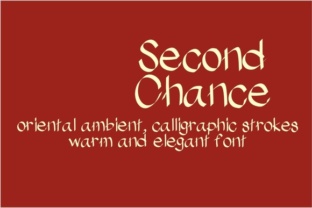
Second Chance is not a conventional serif or sans-serif font. It belongs to a category that might be best described as ambient — a typeface designed to evoke a mood rather than simply convey text. Its oriental influence is evident in the flow of its letterforms, which echo brushstroke dynamics found in East Asian calligraphy. Yet the font remains grounded in Latin character design, making it accessible for English-language projects that need a distinct visual identity.
The calligraphic quality is not aggressive or overly ornamental. Instead, Second Chance uses gentle curves, varied stroke widths, and subtle taper at the ends of letters. This gives it an organic feel that stands apart from mechanically uniform fonts. The warmth mentioned in its description comes from the balance between ink weight and negative space — each character feels deliberate without becoming heavy.
Ambient Atmosphere Without Losing Readability
One concern with expressive fonts is that they sacrifice legibility for style. Second Chance manages to avoid that trap. The letterforms remain distinct, with enough contrast between strokes to keep words readable at moderate sizes. The ambient quality emerges from the overall texture of a block of text rather than from individual character quirks. This makes it suitable for headlines, pull quotes, and medium-length passages where tone matters as much as content.
For designers and content creators who work with brands in wellness, hospitality, culture, or lifestyle sectors, this balance is particularly valuable. The font can set a relaxed, thoughtful mood without confusing the reader.
Key Characteristics That Define Second Chance
Understanding a font's anatomy helps in deciding where and how to deploy it. Second Chance has several defining features worth noting.
- Calligraphic stroke variation: Thick and thin transitions are present but not extreme. The effect is natural, as if written with a flexible nib or brush.
- Warm contrast: The relationship between foreground and background is gentle. Even at smaller sizes, the font does not feel cold or clinical.
- Oriental structural cues: Certain letterforms — particularly the lowercase a, e, and g — carry a slight diagonal energy reminiscent of brush script. This is subtle enough to avoid looking like a novelty font.
- Generous spacing: The default letter and word spacing support an airy, unhurried reading experience. This contributes directly to the ambient quality.
- Consistent weight distribution: Across the character set, the visual weight stays even. No single letter pulls attention away from the rest.
These characteristics combine to create a typeface that feels both personal and professional. It is not a display font meant for shouting — it is a font for speaking with calm authority.
Real-World Performance and Practical Strengths
In practical use, Second Chance performs well in contexts where visual tone is part of the message. A boutique hotel website, for example, might use it for room descriptions and amenity lists. The warm, ambient quality reinforces the idea of comfort and care. Similarly, a mindfulness app could use it for onboarding screens or journaling prompts, where the typography itself invites reflection.
Print applications also benefit. Brochures, menus, and event invitations that rely on texture and mood will find Second Chance a reliable choice. The calligraphic strokes reproduce well at moderate resolution, and the font maintains its character even on uncoated paper stock.
Flexibility Across Media
Because Second Chance is not overly decorative, it can be paired with other typefaces without clashing. A clean sans-serif like Open Sans or Lato works well for body copy, while Second Chance handles headings and accents. This adaptability makes it a useful addition to a designer's toolkit rather than a one-purpose specialty font.
For digital use, the font performs adequately on screen when set at 16px or larger. At very small sizes — such as captions or footnotes — the stroke variation may reduce legibility, so it is best reserved for primary content areas.
Quality and Consistency Across the Character Set
A font is only as reliable as its least-consistent character. With Second Chance, the quality control is evident. The full character set — including numerals, punctuation, and accented letters — follows the same calligraphic logic. There are no weak entries that break the visual flow.
The uppercase letters carry a slightly more formal weight, while lowercase letters retain the organic rhythm. This internal consistency means the font can be used in mixed-case settings without jarring transitions. Headlines set in all capitals also work, though the warm quality is more apparent in sentence case or title case.
Long-Term Value for Content Creators
Investing in a font is, for many professionals, a long-term decision. Second Chance holds up well over repeated use because it does not rely on trends. Its oriental ambient character is not tied to a particular design fad — it draws from a tradition that predates digital typography. This gives it a timeless quality that will not look dated in a few years.
For freelancers and small business owners who build brand assets gradually, a font like Second Chance can become a signature element. It is distinctive enough to be recognizable but restrained enough to remain professional across different campaigns.
Who Benefits Most from Second Chance
Not every project needs an ambient calligraphic font. But for certain audiences and purposes, Second Chance delivers clear advantages.
- Brand and identity designers working with clients in hospitality, wellness, culture, or lifestyle will find the font aligns with brand values like warmth, authenticity, and mindfulness.
- Bloggers and content creators who want their written voice to feel personal and unhurried can use Second Chance for headings and featured quotes.
- Publishers and editors producing print or digital magazines focused on travel, design, food, or slow living will appreciate the font's ability to set a contemplative tone.
- Small business owners creating their own marketing materials — menus, flyers, social media graphics — can achieve a polished look without hiring a designer, as long as they pair the font with clean layout choices.
- Educators and course creators who produce presentation slides or worksheets for topics like art, history, or creative writing can use Second Chance to signal a thoughtful, engaging environment.
Possible Limitations to Consider
No font is universal, and Second Chance has boundaries worth noting. Its ambient quality means it may not suit high-density information layouts such as data dashboards, legal documents, or e-commerce product grids. In those settings, the calligraphic strokes could feel out of place or reduce scanning speed.
Similarly, very small text sizes — below 14px on screen or below 10pt in print — will lose some of the nuance that makes the font appealing. The stroke contrast, while moderate, still requires enough room to register visually.
For multilingual projects that include non-Latin scripts, Second Chance provides only the Latin character set. It is not a solution for global content unless the project is primarily English-language with occasional accented characters.
Finally, the ambient mood may not align with brands that need to project speed, urgency, or technical precision. A fintech startup or a logistics company would likely choose a more neutral typeface.
Pairing and Implementation Recommendations
For those who decide to use Second Chance, thoughtful pairing extends its versatility. A few practical suggestions:
- Pair with a geometric sans-serif such as Montserrat or Nunito for contrast between organic headings and clean body text.
- Use generous line height — around 1.6 to 1.8 — to preserve the airy feel in paragraph settings.
- Avoid heavy letter-spacing adjustments; the default spacing is already part of the font's ambient character.
- Test the font on both light and dark backgrounds. On dark backgrounds, the warm quality becomes more prominent and can be especially effective.
Final Considerations Before You Choose Second Chance
Second Chance offers something that many functional fonts do not: a distinct emotional register. Its oriental ambient character brings warmth, calm, and a subtle handcrafted feel to any project where those qualities matter. For professionals who value typography as a tool for shaping perception, this font provides a reliable and aesthetically coherent option.
The decision to use it should come down to fit. If your project needs to communicate trust, reflection, or quiet beauty — and if the audience will benefit from a reading experience that feels deliberate rather than rushed — Second Chance is worth serious consideration. It is not a font for every job, but for the right job, it may be exactly what you need.