Handy Typography: Reviving Eighteenth-Century Poster Aesthetics in Modern Design
The Origins of Handy and Its Eighteenth-Century Poster DNA
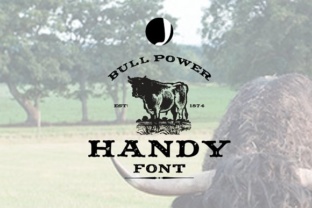
Typography carries history within every curve, serif, and stroke. Handy is not merely a font—it is a direct lineage to the hand-painted lettering that dominated European street corners during the 1700s. In that era, posters were functional artworks, crafted by sign painters who developed distinctive letterforms out of necessity and creativity. The thick, expressive strokes and irregular spacing that characterize Handy echo the physical constraints of brush-on-wood lettering, where paint consistency and wrist pressure shaped each character uniquely.
What makes Handy particularly compelling for contemporary audiences is its refusal to be sanitized. Unlike many revival fonts that smooth over imperfections, Handy retains the grit of original poster typography. The ink bleeds, the slight misalignments, and the variable stroke widths are not errors—they are features that transport viewers to a time when printed matter was tactile and immediate. Designers working with branding or editorial projects often find that Handy injects a narrative depth that sterile digital fonts cannot replicate.
Why Handy Resonates Across Creative and Commercial Contexts
The appeal of Handy extends beyond nostalgia. In a visual landscape saturated with minimal sans-serifs and geometric precision, the irregular warmth of Handy offers differentiation. Professionals in advertising, packaging, and environmental graphics have adopted Handy to signal authenticity and craftsmanship. A coffee roaster using Handy on a bag label communicates small-batch dedication; a music festival poster set in Handy evokes the raw energy of street performance.
Consider how a museum exhibition about maritime history might use Handy for its title treatment. The font's eighteenth-century roots align naturally with colonial-era themes, but the application does not feel costumed. Instead, it feels true. This is because Handy does not mimic history—it carries history. The letters themselves appear worn by time, weathered like a ship's log recovered from saltwater. That emotional weight is something modern typefaces often strive for but rarely achieve without looking forced.
Practical Characteristics of Handy for Designers and Developers
Understanding Handy’s technical attributes helps users deploy it effectively. The font family typically includes multiple weights, from a light version suitable for body text in short doses to a bold weight that commands attention at large sizes. The letterforms are characterized by:
- Expressive ascenders and descenders that create strong vertical rhythm
- Inconsistent x-heights that mimic hand-lettering inconsistency
- Wide counter spaces in letters like e, a, and o, which improve legibility even when the texture is rough
- Swash capitals in select characters that add decorative flourish without overwhelming the reading experience
For web designers, implementing Handy requires attention to rendering. Because the font relies on subtle variations in stroke thickness, it performs best on screens with high pixel density. Using Handy at display sizes—above 36 pixels—preserves its detail, while smaller sizes may cause the delicate variations to blur. Responsive design strategies should include fallback options that maintain the vintage character, such as pairing Handy with a slab serif like Rockwell or a sturdy Clarendon for body copy.
Developers working with CSS should note that Handy benefits from generous letter-spacing adjustments. The default spacing often feels tight because the original poster lettering was designed to be read from a distance. Increasing letter-spacing by 0.5 to 1 pixel for body-sized text improves word recognition. For headlines, negative tracking can create a cohesive block of texture that reads as a single visual entity.
Packaging and Product Identity
A craft distillery recently used Handy on a small-batch rye whiskey label. The proof of concept was immediate: the typeface conveyed the grain-to-glass process more effectively than any illustration could. The uneven baseline suggested handmade craftsmanship, while the bold weight anchored the label against the dark glass. Consumers reported perceiving the product as more authentic compared to competitors using standard serifs. This is not coincidental—Handy triggers what cognitive psychologists call processing fluency, where difficult-to-read fonts actually increase engagement because the brain works harder to decode the message, leading to deeper encoding of the brand.
Event Posters and Cultural Marketing
Music venues, theater companies, and literary festivals have become early adopters of Handy. A theater production of The Crucible used Handy for its promotional materials, and the effect was striking. The font's irregular weight mirrored the unstable emotional state of the characters, while its historical associations placed the story firmly in its 1692 setting without needing explicit period iconography. The poster worked on two levels: as informational design and as thematic commentary.
Digital and Print Publishing
In editorial design, Handy is often reserved for pull quotes, chapter openers, and section breaks. A travel magazine covering remote villages in Eastern Europe used Handy for location headers. The typeface mimicked the hand-painted signs found in those villages, creating a seamless visual bridge between the photographs and the text. Readers commented that the typography made them feel as though they were reading a journal discovered in a dusty attic rather than a mass-produced publication.
Considerations for Pairing Handy with Other Typefaces
No font exists in isolation, and Handy demands thoughtful companions. The best pairings respect Handy's historical weight while providing contrast in structure and mood. Common approaches include:
- Handy + a clean sans-serif such as Helvetica Now or Inter. The neutrality of the sans-serif allows Handy to carry the expressive load without visual competition. This pairing works well for websites that need readability in body text while maintaining personality in headings.
- Handy + a transitional serif like Baskerville or JT Plantin. The eighteenth-century origins of both typefaces create a harmonious period feel, with the serif providing legibility and Handy providing texture. This combination excels in long-form editorial.
- Handy + a monospace such as IBM Plex Mono or Courier. The mechanical rigidity of monospace contrasts sharply with Handy's organic form, generating visual interest that suits tech culture publications or creative agency portfolios.
Avoid pairing Handy with other decorative or script fonts, as the result often becomes chaotic. The eye needs a resting point, and the second typeface should serve as a stable foundation. Additionally, avoid using Handy in all-caps for extended passages. The font's beauty lies in its ascenders and descenders; capitalizing every character erases that rhythm and creates a wall of dense texture that fatigues readers.
Digital Performance and Accessibility Implications
Using Handy responsibly means considering all users. The font's vintage character can reduce readability for people with visual impairments or reading disorders like dyslexia. The inconsistent stroke widths and variable letter shapes, while aesthetically valuable, create cognitive friction. Mitigation strategies include:
- Reserving Handy for headings and short emphasis text (under 50 characters per line)
- Providing sufficient color contrast, especially when Handy is used over background textures
- Offering a toggle in digital products that switches to a more legible typeface for users who prefer it
- Avoiding italic versions of Handy for body text, as the slant further distorts letter recognition
Performance-wise, Handy is typically distributed as a variable font or in WOFF2 format, which keeps file sizes manageable. A single weight usually runs between 40 and 70 kilobytes, and a full family with five weights may reach 250 kilobytes. For comparison, this is lighter than many modern super-families but heavier than basic system fonts. Loading Handy from a self-hosted source rather than a third-party CDN improves control over caching and reduces layout shift.
Creative Workflows: Incorporating Handy into Existing Projects
The most successful implementations of Handy come from designers who treat it as a material rather than a selection. Start by setting Handy at its intended size—large enough to see the brush texture. Scale it down only after establishing the visual hierarchy. In print production, test Handy at actual size on the intended paper stock. Glossy papers smooth out the font's rough edges, while uncoated stocks enhance them. Digital mockups rarely capture this difference.
For motion graphics, Handy animates surprisingly well. Because the letters have irregular edges, simple fades and zooms feel more organic than with geometric fonts. Avoid extreme skewing or distortion of Handy in after-effects, as the letterforms already contain expressive variation—further manipulation often makes them illegible. Instead, let the font's inherent character drive the motion: a slow rotation or a subtle displacement map that mimics paper texture.
Photographers and visual artists incorporate Handy into their workflow by overlaying the typeface onto distressed backgrounds. A photograph of a brick wall, an aged parchment texture, or a weathered wooden surface becomes the perfect canvas for Handy. The key is ensuring the background texture and the font texture do not compete. If the background has high-frequency noise, reduce the font's opacity slightly or apply a subtle drop shadow to separate the letters from the texture.
The Future of Vintage Typography in a Digital-First World
Handy represents a broader movement toward typography that feels human. As artificial intelligence generates increasingly perfect letterforms, designers are seeking imperfection as a mark of authenticity. Handy and fonts like it occupy a unique position: they are digital files that behave like analog artifacts. This duality is exactly what contemporary audiences crave—the convenience of digital distribution combined with the soul of handmade craft.
We are already seeing Handy used in unexpected contexts. A fintech startup uses Handy in its investor presentations to suggest stability and tradition, counteracting the industry's tendency toward cold efficiency. A yoga studio uses Handy on its schedule cards to convey warmth and accessibility. These applications demonstrate that Handy is not limited to historical projects; it is a tool for storytelling across any sector where trust and personality matter.
Typography trends tend to cycle every fifteen to twenty years, but the appeal of eighteenth-century poster lettering has enduring roots. The original sign painters who developed these letterforms were solving the same problem designers face today: how to make words stop people in their tracks. Handy provides not just letters, but a method—a way of saying that something matters enough to be written by hand, even when it is rendered in pixels. That intention, embedded in every stroke, is what makes Handy more than a vintage style font. It is a bridge between centuries of visual communication, and its relevance shows no sign of fading.