Simplecaps: A Practical Evaluation of the All-Caps Script Font
When exploring display typefaces for branding, headlines, or packaging, the sheer volume of options can feel overwhelming. Among the more distinctive choices is Simplecaps, a script font that operates entirely in uppercase while including all standard characters and numerals. This alone sets it apart from conventional script faces, which typically rely on lowercase forms to create their characteristic flow. Understanding what Simplecaps offers and where it fits into real projects requires a closer look at its design, its strengths, and the tradeoffs that come with an all-caps script approach.
What Makes Simplecaps Distinctive
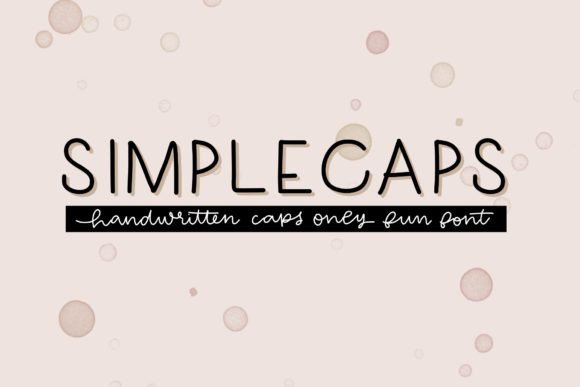
Simplecaps is not a traditional script font in the sense of mimicking handwritten cursive with varied letter heights and connecting strokes. Instead, it delivers a consistent capital-letter silhouette across every character, maintaining the ornamental feel of a script while removing the variability of ascenders and descenders. This design choice gives the font a uniform baseline and cap height, which can simplify layout decisions in ways that conventional scripts cannot.
The font includes a full character set: all uppercase letters, numerals, punctuation, and commonly used symbols. For designers and content creators who need a script that works across multilingual text or includes specific symbols for technical or promotional copy, this completeness is a practical advantage. Many script fonts limit their character coverage, requiring substitutions or manual adjustments. Simplecaps avoids that friction by offering a comprehensive set out of the box.
Visual Characteristics and Design Intent
The letterforms in Simplecaps are constructed with smooth, flowing strokes that evoke handwritten calligraphy, yet each capital letter stands independently. The connections between characters are subtle rather than overt, which preserves legibility even at smaller sizes. The weight distribution across strokes suggests a brush or broad-nib pen influence, giving the font a textured, human quality that contrasts with more geometric or uniform typefaces.
The intent behind Simplecaps appears to be versatility within a specific aesthetic. It is not trying to replicate a spontaneous handwritten note or a formal calligraphy piece. Rather, it occupies a middle ground: structured enough for repeated use across a brand system, yet expressive enough to convey personality. This balance is not easy to achieve, and the all-caps format is a deliberate constraint that shapes how the font can be applied.
Strengths and Practical Value in Real Projects
One of the strongest arguments for using Simplecaps is its efficiency in headline and display settings. Because every character shares the same height, you can set titles, taglines, or short blocks of text without worrying about uneven spacing or awkward gaps that sometimes appear when lowercase and uppercase letters interact in traditional scripts. This uniformity saves time during layout and reduces the need for manual kerning adjustments.
The font also performs well in contexts where emphasis and authority are important. An all-caps script naturally commands attention without needing additional styling like bold weights or underline effects. For logos, product names, or event headers, Simplecaps can deliver a polished, deliberate look that feels both crafted and approachable. The script quality adds warmth, while the capital consistency keeps the presentation organized.
Usability Across Media
From a usability standpoint, Simplecaps works across both print and digital environments. On screen, the even cap height helps maintain readability at medium sizes, which is useful for social media graphics, website banners, or presentation slides. In print, the font holds up well in situations where a script is desired but traditional cursive options might become too delicate or irregular at larger point sizes.
The inclusion of numerals is another practical detail. For event materials, pricing displays, or date references, having a matching numeral set that shares the script aesthetic is often overlooked. Simplecaps ensures that numbers do not feel like an afterthought. This consistency across the full character set strengthens the overall visual identity when numbers appear alongside text.
Quality, Consistency, and Reliability
Evaluating the quality of a font like Simplecaps involves looking at how it performs under repeated use. The stroke construction is generally smooth, and the curves avoid the abrupt transitions that can make some script fonts appear mechanical. The spacing between letters is reasonably consistent, though as with any display font, occasional kerning tweaks may be necessary depending on specific letter pairs.
In terms of reliability, Simplecaps handles well across common design software and operating systems. The font file is structured to support standard encoding, which means it should work without unexpected substitutions or missing glyphs. For designers who need a dependable script that does not require constant troubleshooting, this reliability matters more than novelty.
Long-Term Value for Brand Use
For businesses or creators considering a font for ongoing use, longevity is a factor. Simplecaps is not a trend-driven design; its all-caps script format has a classic appeal that does not depend on current stylistic fads. A brand that adopts this font for its logo or core materials can expect it to remain visually relevant for several years, provided the overall brand identity is updated periodically to stay fresh.
That said, the font is best suited as an accent or headline face rather than a body text font. Using it for long paragraphs would strain readability, and the all-caps format can feel overpowering in large quantities. This is not a weakness of the font itself but a characteristic of its intended use. Recognizing this distinction helps designers deploy Simplecaps where it will have the greatest impact.
Who Benefits Most from Simplecaps
Professionals working in branding and identity will find Simplecaps useful when they need a script that reads clearly at multiple sizes and retains its character across different applications. Entrepreneurs and small business owners who manage their own marketing materials can benefit from the font's straightforward handling; it does not require extensive typography experience to produce decent results.
Marketers and content creators who frequently design social media posts, email headers, or promotional graphics will appreciate the uniformity that Simplecaps provides. Because the font maintains a consistent height, arranging text for different platforms becomes faster, and the visual result remains cohesive. Bloggers and publishers who want to add a distinctive touch to article titles or section headers can also use Simplecaps effectively without redesigning their entire layout.
Specific Use Cases and Examples
Consider a brand launching a premium product line. Using Simplecaps for the product names on packaging creates a sense of craftsmanship without appearing overly ornate. The all-caps script suggests quality and attention to detail, while the uniform height keeps the packaging readable from a distance.
For an event poster, Simplecaps can handle the main headline and key details such as dates and location. The script style adds elegance, and the consistent capital format ensures that attendees can quickly parse the essential information. In this context, the font reduces the cognitive load that sometimes comes with reading elaborate scripts.
Freelancers and creators developing their own brand assets may find Simplecaps a cost-effective solution that does not require multiple font weights or stylistic alternates to be effective. One well-chosen typeface can anchor an entire visual identity, and Simplecaps provides enough presence to serve that role without needing supplementary fonts for the same purpose.
Practical Considerations and Possible Limitations
No font is universally ideal, and Simplecaps has constraints worth noting. The all-caps format, while advantageous for uniformity, can reduce the visual variety that mixed-case scripts offer. If your project depends on the natural rhythm of ascenders and descenders to convey a specific mood, Simplecaps may feel too even or repetitive over longer text strings.
Additionally, the font works best at medium to large sizes. At very small point sizes, the script details can become less distinct, and the all-caps format may make text appear denser than intended. For applications like small print labels or fine print disclaimers, a simpler sans-serif or serif would likely perform better.
Another consideration is the font's compatibility with certain brand voices. Simplecaps carries a personality that leans toward polished and intentional. For brands that aim for a rugged, informal, or highly experimental look, this font might feel too restrained. Matching the font's character to the brand's tone is essential for authentic communication.
Making the Right Choice for Your Workflow
Deciding whether Simplecaps fits your needs involves evaluating your typical projects, audience expectations, and design constraints. If you regularly produce materials where a script accent is appropriate and you value consistency across characters, this font offers a reliable solution. If your work demands maximum flexibility in letterform variation or requires extensive body text in a script style, other typefaces may serve you better.
Testing the font in your actual design environment is the most reliable way to assess its fit. Try it in a few mockups, see how it behaves with your typical color schemes and layouts, and pay attention to how it reads at various sizes. Practical testing often reveals nuances that browsing font previews cannot capture.
Final Observations on Simplecaps
Simplecaps occupies a specific niche in the typography landscape: it delivers the personality of a script without the layout complications that often accompany mixed-case designs. For professionals and creators who need a dependable, all-caps script font with complete character coverage, it is a practical tool that balances aesthetics with functionality. Its strengths lie in headline use, branding contexts, and any application where clarity and character must coexist.
Understanding what Simplecaps does well and where its limitations appear allows you to use it with intention. When chosen for the right project, it can elevate the visual communication without introducing unnecessary complexity. For those who value efficiency alongside expression, Simplecaps deserves consideration as part of a well-rounded type toolkit.