Redgar Slab: Understanding an Eroded Slab Serif Typeface for Modern Design
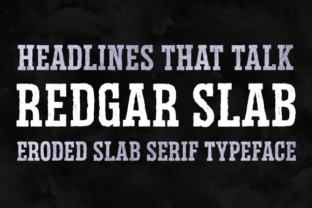
When you scroll through a font library, most typefaces appear polished, clean, and uniform. Every curve is smooth, every edge intentional. Then you encounter something like Redgar Slab, and the rules shift. Created by type designer Deepak Dogra, Redgar Slab is an eroded slab serif that brings a deliberate rawness to typography. It is not a font that tries to disappear into the background. Instead, it asks to be noticed through its texture, its irregularities, and its refusal to conform to conventional finish quality.
For anyone selecting type for branding, editorial design, or digital interfaces, understanding what Redgar Slab offers — and where it may fall short — is essential. This article explores the font's character, compares it with similar stylistic categories, examines practical tradeoffs, and helps you decide when it fits your project and when another choice might serve better.
What Redgar Slab Is and What Makes It Distinct
Redgar Slab belongs to the slab serif family, a category known for thick, block-like serifs that give typefaces a sturdy, confident appearance. But where most slab serifs aim for consistency and geometric precision, Redgar Slab introduces erosion. The letterforms appear distressed, as if they have been weathered by time or use. Edges are not crisp; surfaces are not flat. This gives the font a tactile, analogue quality that feels grounded and historical, yet still functional in contemporary contexts.
Deepak Dogra designed Redgar Slab to occupy a space between legibility and expression. It is not so eroded that it becomes unreadable, but the texture is prominent enough to influence the mood of any text set in it. The weight tends toward the bold side, making it suitable for headlines, posters, and display use rather than long body copy. The erosion is uneven across characters, which adds to the handcrafted feel. No two letters feel mechanically identical, even when repeated.
This distinctiveness is both the font's greatest strength and its most significant limitation. It communicates authenticity, history, and character, but it also imposes constraints on where and how it can be used effectively.
How Redgar Slab Compares with Similar Typeface Categories
To evaluate Redgar Slab fairly, it helps to place it alongside the stylistic alternatives a designer might consider. The most relevant comparisons include standard slab serifs, distressed or grunge typefaces, and hand-drawn or brush lettering. Each category serves a different purpose, and understanding the differences clarifies when Redgar Slab is the stronger choice and when another direction may be more practical.
Redgar Slab versus Polished Slab Serifs
Traditional slab serifs like Rockwell, Clarendon, or Courier are designed with precision. Their serifs are uniform, their curves predictable, and their spacing mathematically consistent. They convey stability, authority, and clarity. Redgar Slab shares the slab structure, but replaces uniformity with texture. A polished slab serif is ideal for corporate reports, legal documents, or any context where readability and neutrality are paramount. Redgar Slab, by contrast, introduces personality and a sense of age. If your project requires absolute clarity and professional neutrality, a polished slab serif will serve you better. If you want to evoke craftsmanship, history, or a handmade feel, Redgar Slab offers something those fonts cannot.
Redgar Slab versus General Distressed Fonts
Distressed fonts are abundant, ranging from heavily grunge styles that mimic spray paint or decay to subtly worn typefaces that suggest gentle use. Many distressed fonts sacrifice legibility for effect. Redgar Slab strikes a more careful balance. Its erosion is controlled enough that words remain readable at medium to large sizes. Where a heavily grunge font might blur into noise, Redgar Slab retains the underlying slab serif structure, so the texture enhances rather than overwhelms the letterform. This makes it more versatile for projects where the text needs to be read, not just seen.
Redgar Slab versus Hand-Drawn or Brush Lettering
Hand-drawn typefaces offer organic irregularity, but they often lack the consistency needed for extended text or repeated use. Brush lettering can feel spontaneous, but it may not work well across different contexts. Redgar Slab provides a middle ground. It has the irregularity of handcrafted work but maintains the predictability of a designed typeface. Letters maintain consistent x-height, weight distribution, and baseline alignment, which helps when setting multiple lines of text or when using the font across a brand system. If you need the spontaneity of hand lettering with more structure, Redgar Slab is a pragmatic compromise.
Strengths and Best-Fit Situations
Redgar Slab excels in contexts where the visual tone matters as much as the message itself. Its eroded texture communicates history, durability, and authenticity. These are valuable associations for brands in industries like craft brewing, artisanal food, vintage clothing, independent publishing, and cultural institutions.
Headlines and display text are natural applications. At large sizes, the erosion becomes a visual feature, drawing the eye and establishing mood. A poster for a film festival or a book cover for a historical novel could benefit from the font's weathered character. In editorial design, it works well for section openers or pull quotes where the typography needs to stand apart from body text.
Logotype and branding are also strong use cases. Because Redgar Slab is distinctive without being illegible, it can anchor a brand identity that wants to feel established and grounded. A coffee roastery or a leather goods workshop might choose it to signal tradition and quality. The font's texture works especially well when paired with simple, clean secondary typefaces to create contrast.
Short-form digital content can also benefit. Social media graphics, YouTube thumbnails, or website hero sections where text is large and brief can carry the font's personality without sacrificing readability. However, it is important to avoid using it for long paragraphs, especially at small sizes, as the erosion can cause visual fatigue.
Limitations and Tradeoffs to Consider
No typeface works everywhere, and Redgar Slab has clear boundaries. The most immediate limitation is legibility at small sizes. Below 16–18 points, the erosion begins to blur letterforms, especially on screens with lower resolution. Body text, footnotes, captions, or any extended reading passage will strain the reader's eyes. For these purposes, a cleaner slab serif or a neutral sans-serif is more appropriate.
Another tradeoff is tonal inflexibility. Redgar Slab carries a strong personality. That is its appeal, but it also means it cannot easily adapt to different moods. A modern tech startup, a healthcare provider, or a financial institution would likely find the font too rustic or informal. Even within creative fields, not every project needs a worn aesthetic. If your brief calls for sleekness, minimalism, or futurism, Redgar Slab will feel out of place.
Additionally, because the erosion is irregular, Redgar Slab requires careful spacing and layout adjustments. Auto-kerning may not account for the texture, so manual kerning becomes more important. Designers should test the font in context before committing, as the visual weight of the erosion can shift depending on surrounding elements and background color.
Licensing is another practical consideration. Before using Redgar Slab in commercial projects, verify the license terms. Some font distributors offer it for personal use only, while others require a commercial license. Budget for this if you plan to use it in client work or product design.
When Redgar Slab May Be the Right Choice
You should consider Redgar Slab when your project needs to convey authenticity, age, or craftsmanship. It works well for:
- Brands with a heritage or artisanal angle
- Posters, flyers, and print collateral for cultural events
- Book covers, especially fiction or history genres
- Short-form digital display text where mood matters
- Logotypes or wordmarks for small businesses
If your audience values handmade quality over machine precision, Redgar Slab can help you communicate that value without needing additional graphic effects. It does the work of texture on its own.
When You May Need Another Option
Consider alternatives when your project requires:
- Long-form readability at small sizes
- A neutral, professional, or modern tone
- Consistency across a wide range of applications
- High-resolution screen rendering at low point sizes
- Compliance with accessibility standards that demand clear letter differentiation
For these situations, a clean slab serif, a humanist sans-serif, or a well-crafted transitional serif will serve better. Redgar Slab is a specialty tool — effective in its niche but not a universal solution.
Making an Informed Decision
Choosing a typeface is rarely about finding the single best option. It is about matching the font's characteristics to the project's goals, audience, and medium. Redgar Slab offers a specific texture and emotional register that many other slab serifs avoid. If your design brief calls for warmth, history, and tactile presence, it deserves serious consideration.
However, treat it as you would a distinct color or material. Use it deliberately, and limit its scope to where it adds value. Pair it with a clean secondary font for body text and smaller elements. Test it at actual use sizes on the intended medium. And always ask whether the erosion enhances the message or distracts from it.
Deepak Dogra has created a font that is not afraid to show wear. In a design landscape dominated by polished perfection, Redgar Slab stands out by embracing imperfection. That makes it memorable. Whether it is right for your project depends on whether your audience is ready to remember something that looks a little less perfect — and a lot more human.