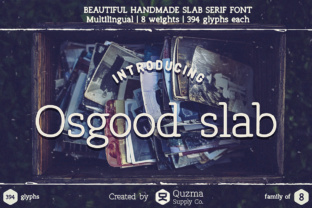
Osgood Slab: A Clean Slab Serif Built for Real Projects
If you have spent any time browsing for typefaces that balance readability with personality, you have likely come across slab serifs. They carry a certain weight—a grounded, confident look that sans-serifs sometimes lack. Osgood Slab is one of those families that quietly does a lot of the heavy lifting in design work. It is clean, dependable, and surprisingly versatile once you start putting it to use.
What makes Osgood Slab stand out is not just its structure, but the way it settles into a page. It does not shout. It holds space well. And that makes it a strong candidate for a wide range of projects—whether you are building a brand, laying out a magazine, designing signage, or working on something purely digital.
Why Osgood Slab Works Well at Slightly Larger Sizes
One of the first things you notice with Osgood Slab is how it behaves when you scale it up. At body text sizes, it is perfectly legible. But where it truly finds its rhythm is at slightly larger sizes—think subheadings, pull quotes, or short paragraphs of emphasis. The slab serifs become more pronounced, the letterforms feel intentionally crafted, and the whole texture of the text becomes more inviting.
This makes it a strong choice for anything where you want people to actually pause and read. A product description on a landing page. A short block of copy in a brochure. A few lines on a poster that need to carry meaning without overwhelming the layout. When you give Osgood Slab a little room, it rewards you with clarity.
Real-World Scenarios Where Osgood Slab Fits Naturally
Rather than listing features, it helps to imagine where this font family actually lives in the wild. Here are a few scenarios where Osgood Slab tends to perform well.
Small Business Branding That Needs to Feel Solid
Imagine a local coffee roastery or a small-batch bakery. They want their packaging, menu boards, and website to feel approachable but not flimsy. Osgood Slab in Regular or Bold gives off exactly that impression. It is friendly enough for a neighborhood shop but structured enough to feel professional. The Bold weight works well for the business name on a bag of beans, while the Regular or Italic handles ingredient lists or origin stories on the back.
The family offers eight distinct styles, so you are not stuck pairing fonts from different families that may or may not get along. Everything is already designed to work together. For a small business owner working with a designer—or even doing the design themselves—this saves a lot of guesswork.
Editorial Layouts That Need a Reliable Workhorse
If you have ever laid out a newsletter, a zine, or a multi-page report, you know the struggle of finding a typeface that can handle both headlines and body copy without feeling mismatched. Osgood Slab straddles that line well. The Bold or Bold Italic can anchor a title, while the Light Blur or Regular carries the reading flow. The Outline styles (both Blur and Bold) add a subtle graphic element for section breaks or decorative drops without needing additional illustration.
For someone producing a quarterly magazine or a community publication, this kind of built-in versatility means fewer font licenses to manage and a more cohesive visual identity across pages.
Signage and Environmental Graphics
Slab serifs have a long history in signage precisely because they hold up at a distance and in various lighting conditions. Osgood Slab, especially in Bold or Outline Bold, works well for wayfinding, exhibit labels, or wall quotes in a retail or hospitality space. The clean shapes mean the letters do not get muddy when scaled up or viewed from an angle.
A museum gallery using Osgood Slab Bold for wall texts and Osgood Slab Light Blur for secondary captions creates a layered experience without needing multiple type families. The visual continuity helps visitors move through the space without feeling overwhelmed by typographic shifts.
Digital Projects That Benefit from a Human Touch
On screens, many slab serifs can feel heavy or clunky. Osgood Slab, because of its clean construction, translates reasonably well to digital environments—especially when used at the slightly larger sizes it prefers. A blog or online publication that wants to stand out from the sea of sans-serif competitors can use Osgood Slab for article headers and short introductory paragraphs. The Bold Italic style, for example, adds a conversational emphasis that works well for pulling readers into a story.
For landing pages or product pages where you want to convey durability or craftsmanship (think furniture, tools, or outdoor gear), Osgood Slab Regular or Bold sets the right tone without feeling overly decorative.
How Different Audiences Might Use Osgood Slab
The beauty of a font family with eight distinct styles is that different people will gravitate toward different parts of it depending on their goals.
Designers and Creative Professionals
For designers, Osgood Slab offers a predictable, well-behaved toolset. The Regular and Bold weights cover most needs, while the Blur and Outline variations open up possibilities for layered typography, watermark effects, or subtle background textures. Designers working on brand guidelines will appreciate that the family maintains consistent proportions across styles, making it easier to spec for clients who may not have a trained eye for typography.
Small Business Owners and Entrepreneurs
Someone launching a product or opening a physical space often has to make quick decisions about their visual identity. Osgood Slab gives them a shortcut. They can pick a primary style (probably Bold for the name) and a secondary style (Regular or Italic for supporting text) and move forward without overthinking. The fact that the family includes an Outline Bold as well means they can create a logo lockup or a watermark without hiring an illustrator.
Artists and Makers
For artists producing prints, zines, or exhibition materials, Osgood Slab provides a textural quality that pairs well with both photography and illustration. The Blur styles, in particular, feel a bit softer and more atmospheric, which can be useful for titles over layered images. An artist working on a series of limited-edition prints might use Osgood Slab Outline Bold for the series title and Osgood Slab Light Blur for the edition numbering—creating a cohesive system that feels intentional rather than thrown together.
Common Considerations Before Choosing Osgood Slab
No font family is perfect for every situation, and being honest about that helps you make better choices.
Where It Shines
- Medium to larger text sizes: This is where Osgood Slab really comes into its own. Below 10 or 11 points, some of the subtleties of the slab serifs get lost, especially in the lighter weights.
- Short to medium-length reading passages: For paragraphs that run longer than a few hundred words, you might want to pair it with a highly readable sans-serif for body copy. The Bold and Outline styles are better suited for emphasis than for extended reading.
- Projects that need a grounded, approachable tone: If your content is formal or highly technical, a more neutral font might serve you better. Osgood Slab carries a bit of warmth and personality.
Potential Limitations
- Very small sizes: At small sizes on low-resolution screens, the slab serifs can blur together. If your primary use case is dense mobile body copy, test it thoroughly before committing.
- Formal or corporate contexts: While Osgood Slab works well for many businesses, it may feel too casual for traditional law firms, financial institutions, or luxury brands that rely on more restrained typography.
- Pairing with other fonts: Because Osgood Slab has a distinct personality, it does not pair well with every font. Neutral sans-serifs or simple geometric sans work best. Avoid pairing it with another slab serif or a highly decorative display font.
Practical Observations from Using Osgood Slab
After spending time with the full family, a few patterns emerge. The Bold Blur style is one of those hidden gems—it works beautifully as a large, faded background element or as a title over a dark image. The Outline Bold, used sparingly, adds a nice structural accent in headers without needing to introduce a separate display font. And the Italic style, often an afterthought in many families, has enough personality to carry short pull quotes or captions on its own.
The Light Blur is perhaps the most niche of the group. It is soft enough that it almost reads as texture rather than text, which makes it useful for things like watermarked page numbers, decorative initials, or low-opacity background titles. It is not a workhorse weight, but it adds depth when you need it.
If you are considering Osgood Slab for a project, the best approach is to start with the Bold and Regular weights. Build your core layout with those, then layer in the other styles for accents, emphasis, or decorative elements. This keeps the hierarchy clean and ensures the more unusual styles feel intentional rather than random.
Osgood Slab in Print Versus Digital
This family handles both print and digital environments well, but with slightly different strengths. In print, the slab serifs catch light nicely, especially in the Bold and Outline styles. On uncoated paper or textured stocks, the letterforms retain their shape without filling in. In digital environments, the Regular and Bold weights render cleanly on most screens, and the Outline styles work well as accent elements at larger sizes.
If you are producing something that will exist in both formats—like a brand identity that appears on a website and on packaging—Osgood Slab gives you a consistent voice across mediums. You can use the Bold for headings online and the same Bold for product labels without worrying about how the weight translates.
Final Thoughts on Working with Osgood Slab
Osgood Slab is not trying to be the most neutral or the most adventurous font on the market. It sits somewhere in between, which is exactly where most real-world projects live. Whether you are designing for a local business, a creative passion project, or a publication that needs a dependable voice, this family offers enough range to keep things interesting without forcing you to reinvent your typographic system every few pages.
The eight styles give you room to play, but the consistency across those styles keeps your work grounded. That combination—flexibility without chaos—is harder to find than you might think. If you are looking for a slab serif that works for paragraphs, signage, art, and everything in between, Osgood Slab deserves a close look.