The Elegance of Script Typography: Exploring the BetterFly Font and Its Remarkable Features
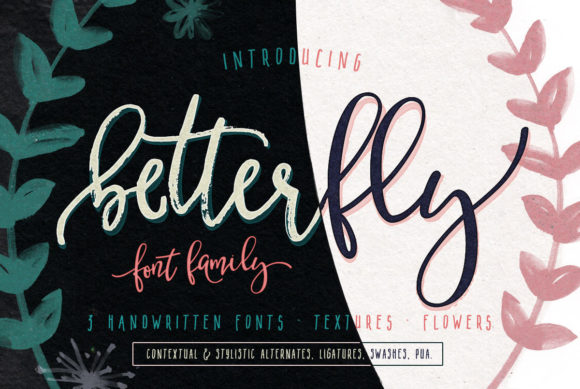
Typography is often the silent storyteller in design. The fonts we choose can evoke emotions, establish tone, and even influence how information is perceived. Among the vast array of typefaces available, script fonts hold a special place. They mimic the fluidity of handwriting, adding a personal, artistic touch to any project. But not all script fonts are created equal. Enter BetterFly, a beautifully crafted script font that combines elegance, readability, and unmatched richness of glyphs. With 565 unique characters and an impressive suite of OpenType features, BetterFly is more than just a font—it’s a design tool that unlocks endless creative possibilities.
Whether you are a professional graphic designer, a small business owner creating your own branding, or a hobbyist exploring typography, understanding what makes BetterFly special can transform the way you approach text in your projects. This article takes you from the ground up, explaining the purpose and significance of script fonts, unpacking the technical brilliance of BetterFly, and showing how it fits into modern creative workflows.
What Are Script Fonts and Why Do They Matter?
Before diving into BetterFly specifically, it helps to understand the broader context of script typography. Script fonts are typefaces designed to imitate the varying strokes of handwriting or calligraphy. They come in two main varieties: formal scripts, which often resemble elegant cursive, and casual scripts, which feel more relaxed and handwritten. For decades, scripts have been used for wedding invitations, luxury branding, logos, and any design needing a touch of sophistication or personality.
In today’s digital world, script fonts are everywhere—from Instagram quotes to restaurant menus. Their popularity stems from their ability to convey authenticity and emotion. However, many script fonts suffer from limitations: limited character sets, poor legibility at small sizes, or a lack of alternates, which makes every use look identical. This is where BetterFly breaks the mold. It was designed with a focus on coherence and variety, ensuring that every word you create strikes the perfect balance between readability, elegance, and uniqueness.
A Deep Dive into BetterFly: Features and Glyph Complexity
BetterFly is not just another script font; it is a typographic ecosystem. With a total of 565 unique glyphs, this font offers an extraordinary level of detail. Each character has been meticulously optimized until perfection, resulting in a font where every letterform is consistent yet full of character. The sheer number of glyphs means you can create text that feels fresh and custom every time you use it—something that is rare in the world of digital type.
The magic of BetterFly lies in its OpenType features. These are advanced typographic capabilities that allow fonts to automatically substitute different glyphs based on context or user preference. BetterFly supports several key OpenType features:
- Contextual Alternates: The font automatically selects the most appropriate letterform depending on surrounding characters. This creates a natural, flowing rhythm that mimics hand-lettering. For example, the shape of a lowercase "a" may change when preceded by a curved letter, avoiding awkward collisions and improving readability.
- Discretionary Ligatures: Ligatures are decorative combinations of two or more characters that merge into a single glyph. BetterFly includes beautiful discretionary ligatures for common letter pairs like "Th," "fi," "fl," and many more. These ligatures add a sense of craftsmanship and flourish, making your text look like it was written with a fine pen.
- Stylistic Alternates: This feature gives you manual control over the appearance of individual letters. You can choose from different versions of a glyph—perhaps a taller ascender, a longer tail, or a more ornate curl. Stylistic alternates allow you to customize the personality of each word, ensuring no two projects ever look exactly the same.
- Swashes and Swooshes: Perhaps the most eye-catching feature, swashes are decorative strokes that extend from letters, often at the beginning or end of words. BetterFly includes a rich set of swashes and swooshes that can be applied to capitals and terminal letters. These are perfect for adding a dramatic, elegant flair to headers, logos, or callout text.
BetterFly is also completely PUA encoded (Private Use Area). This is a technical detail with practical importance: PUA encoding means that all the extra glyphs—swashes, alternates, ligatures—are mapped to Unicode Private Use Area codepoints. As a result, they can be accessed in most design software (like Adobe Illustrator, Photoshop, or CorelDRAW) without needing special workarounds. You can choose any alternate character easily through glyph panels or OpenType controls.
How Many Glyphs Are Enough? The Power of 565
You might wonder: why does a font need 565 glyphs? For comparison, a standard Latin script font often contains about 200–300 glyphs covering uppercase, lowercase, numbers, punctuation, and a few common accented characters. BetterFly’s 565 glyphs go far beyond that. This includes multiple variants for many letters, extended language support, additional ornaments, and the swash elements. The result is a font that gives you near-infinite design flexibility. Every time you type with BetterFly and enable its OpenType features, you create a unique visual experience. This is especially valuable in branding and invitations, where repetition can make designs feel generic.
Practical Applications and Use Cases for BetterFly
Understanding a font’s technical features is one thing; seeing how they apply to real-world projects is another. BetterFly’s combination of readability and ornamentation makes it suitable for a wide range of contexts.
Branding and Logo Design
A logo is the face of a brand. Many boutique businesses, wedding planners, bakeries, and creative agencies opt for script logos because they feel warm and approachable. BetterFly’s contextual alternates ensure that your brand name looks consistent yet dynamic. You can use a stylistic alternate for the first letter to create a distinctive mark, or add a swash to the last letter for a memorable flourish. Because BetterFly has been optimized for coherence, the letters naturally connect and flow, avoiding the disjointed look that plagues some script fonts.
Invitations and Stationery
Wedding invitations, save-the-dates, and formal event stationery demand elegance. BetterFly’s discretionary ligatures and swashes are perfect for setting a romantic or luxurious tone. Imagine a wedding invitation where the couple’s names are tied together with a delicate ligature, or a "Thank You" card with swooping swashes on the capital T. Because the font supports PUA encoding, you can directly access swash variants from your software and customize each letter.
Social Media Graphics and Web Design
On platforms like Instagram, Pinterest, and Facebook, visual uniqueness helps content stand out. BetterFly can be used for quote graphics, headlines, or overlay text on photos. Its readability is strong enough to remain clear on mobile screens, yet it has enough decorative flair to catch the eye. For web designers, using BetterFly as a display font for hero sections or call-to-action buttons can give a site an artisanal feel without sacrificing professionalism.
Product Labels and Packaging
Handcrafted products—jams, soaps, candles, or artisanal coffee—often use script typography to convey craftsmanship. BetterFly’s extensive character set includes many alternate letterforms, so you can create packaging copy that feels handmade. The font’s coherence ensures that product names are legible even at small sizes on labels.
Technical Details: Why PUA Encoding Matters
If you are new to typography, the term PUA (Private Use Area) might sound intimidating, but it is a simple and practical concept. The Unicode standard reserves a block of codepoints for private use, meaning font designers can assign their custom glyphs there. When a font is PUA encoded, all those extra swashes, alternates, and ligatures become easily accessible in software that supports the glyph panel. You don’t need special scripts or plugins; you can just select the character from the font’s glyph palette. BetterFly is fully PUA encoded, so every one of its 565 glyphs is reachable. For designers, this means no frustration trying to access the beautiful swash “Q” or the ornate “&” ligature.
Clarifying Common Misunderstandings About Script Fonts
Despite their popularity, script fonts are sometimes misunderstood. One common assumption is that all script fonts are hard to read. While some overly ornate scripts can indeed compromise legibility, BetterFly was designed with optimization in mind. Each letter has been carefully balanced to ensure that even when swashes are applied, the overall word remains readable. Another misconception is that using many alternates makes text look messy. In BetterFly, the contextual alternates automatically choose appropriate forms, so the result is a natural flow rather than chaotic variation. Finally, some believe script fonts are only for formal occasions. BetterFly’s versatility shows that scripts can work for modern, casual, and even corporate applications when used thoughtfully.
How BetterFly Fits Into Modern Creative Workflows
Today’s designers work across digital and print media. BetterFly is compatible with all major operating systems and design applications. Its OpenType support is fully realized in Adobe Creative Suite, Affinity Designer, and even web typography tools. For web designers, using CSS @font-face with OpenType features can bring BetterFly’s magic to websites, though careful testing for performance and rendering is recommended. The font’s consistency across sizes makes it a reliable choice for both large headlines and smaller subheadings. Additionally, the font’s PUA encoding ensures that even users of prosumer tools like Canva or Cricut Design Space can access swashes and alternates, democratizing high-quality typography for everyone.
Tips for Getting the Most Out of BetterFly
- Experiment with OpenType features: In your design software, turn on contextual alternates and discretionary ligatures first. Then manually apply stylistic alternates or swashes to key letters for emphasis.
- Pair with a clean sans-serif: For body text or supporting information, use a neutral sans-serif font. BetterFly works beautifully with fonts like Montserrat, Open Sans, or Lato, creating an elegant contrast.
- Adjust letter-spacing carefully: Script fonts often benefit from slightly tighter tracking (negative letter-spacing) to enhance the connected, hand-lettered feel. However, avoid going too tight, as swashes may overlap.
- Use swashes sparingly: While swashes are stunning, using them on every capital letter can overwhelm the design. Reserve them for the first and last letters of a word, or for the most important words in a headline.
Conclusion: The Unique Experience of BetterFly
Typography is a subtle art, but it has a profound impact on how messages are received. BetterFly stands as a testament to what a well-crafted script font can offer: a beautiful balance between readability and artistic expression, a vast library of glyphs that prevent designs from looking repetitive, and technical features that give designers precise control. With 565 unique glyphs, comprehensive OpenType support, and full PUA encoding, BetterFly is more than just a font—it’s an invitation to create something truly unique every time you use it.
Whether you are designing a luxury brand identity, a heartfelt wedding invitation, or a social media post that demands attention, BetterFly provides the tools to make your text sing. By understanding its features and applying them thoughtfully, you can elevate your projects and give your words the elegance they deserve.