Renogare: A Clean Sans Serif Font for Strategic Design Decisions
When you choose a typeface, you are not picking a decorative afterthought. You are making a decision that affects how people read, feel, and trust what you present. Renogare, a clean and elegant sans serif font created by Deepak Dogra, offers a tool that goes beyond surface aesthetics. It is designed for clarity, consistency, and a quiet professionalism that serves long-term goals.
In a landscape crowded with fonts that shout for attention, Renogare works differently. It steps back and lets your content lead. For entrepreneurs, marketers, creators, and professionals who manage communication strategy, this distinction matters. The right typeface can support your planning, enhance your brand positioning, and improve how your audience processes information. The wrong one, even if beautiful, can introduce friction.
What Makes Renogare a Strategic Choice
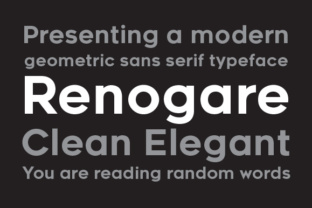
Renogare belongs to the family of geometric sans serif fonts, but it brings its own character. Its letterforms are balanced, proportions are consistent, and the overall impression is one of understated clarity. Without decorative flourishes, it reduces visual noise and directs attention to the message itself.
For anyone who creates content regularly—bloggers, publishers, educators, freelancers—this is directly useful. When you are producing articles, landing pages, guides, or client proposals, the typeface you use shapes reading experience. A font like Renogare helps maintain readability across devices and screen sizes, which is essential for audience retention and action.
But strategy goes beyond readability. Renogare’s neutrality also makes it adaptable. It works for a tech startup’s website, a coach’s workbook, or a small business owner’s branded email template. That versatility means you can plan one typeface system for multiple touchpoints, reducing design inconsistency and the mental overhead of choosing fonts repeatedly.
How Renogare Supports Clear Communication and Branding Goals
Branding is not just about logos and colors. It is about the cumulative experience someone has with your work. Typeface choice is a subtle but powerful part of that experience.
Using Renogare for body text in reports, newsletters, or white papers signals that you value clarity and professionalism. It does not distract with personality; it builds trust by being predictable and easy to follow. This is especially relevant for decision-makers who oversee customer experience or operations. A consistent, legible typeface across contracts, instructions, and emails reduces confusion and supports efficient workflows.
For marketers and creators, Renogare works well in headlines and short text blocks when paired with more expressive display fonts. But it can also stand alone in minimal designs. The key is intentionality. When you choose Renogare because it aligns with your brand values—simplicity, precision, honesty—you reinforce those values every time someone reads your content.
When to Use Renogare: Practical Planning Considerations
No font works for every context. Before committing to Renogare, consider where it adds the most value.
- Digital reading environments: Renogare’s clean lines and open spacing make it suitable for mobile screens and tablets where legibility can suffer. If your audience reads on phones often, this font helps maintain comfort.
- Long-form content: Blogs, guides, documentation, and educational materials benefit from a neutral sans serif that does not cause eye fatigue. Renogare handles extended reading sessions well.
- Business communications: Internal memos, client reports, proposals, and email newsletters can all use a single font for a cohesive professional look. Using Renogare across these channels simplifies design production.
- Minimalist or modern brand identities: If your brand avoids ornamentation and focuses on bare essentials, Renogare reinforces that approach without feeling cold.
However, there are contexts where Renogare may not be the best fit. For very short, high-impact headlines where you want strong personality, a more distinctive or serif font could work better. Also, in print applications where very small sizes are needed, test thoroughly. Some geometric sans serifs lose legibility at tiny point sizes; Renogare handles many sizes well, but always proof in your actual medium.
Strategic Observations: Using Renogare with Intent
One risk of adopting any popular style of font is using it without clear goals. You might see a clean sans serif, think “modern,” and implement it everywhere. That is not strategy; it is following a trend.
To use Renogare intentionally, start with your communication objectives. Ask:
- What emotional or cognitive response do I want from my audience? Calm, trust, focus?
- What is the primary medium? Web, mobile, print, presentation?
- Does my current font system cause any friction? Slow reading, misalignment with brand?
Once you have answers, test Renogare in a controlled piece—like a single landing page or a client report. Gather feedback on readability and perception. Then decide whether to extend it.
Another strategic observation: Renogare works well as a system font when paired with a complementary typeface for accents. For example, use Renogare for body text and a geometric sans serif with slight variations for headings, or a serif for quotes. This creates hierarchy without losing coherence. Plan the pairing carefully to avoid visual conflict.
Long-Term Value: Consistency, Scalability, and Learning
Adopting a font like Renogare can yield benefits over months and years. Consistency across all your materials builds brand recognition. When a client sees your newsletter and then your proposal, the same typeface reinforces that they are dealing with the same organization. This reduces cognitive friction and strengthens trust.
From an operations perspective, a single typeface simplifies asset creation. Freelancers and small business owners who hire designers or use templates save time because the font standard is set. You avoid the cost of purchasing multiple licenses or managing several font families.
Renogare also supports learning and professional development. Educators and course creators can use it in handouts and slides to reduce visual distractions, helping learners focus on content. The font’s neutrality means it does not compete with diagrams, icons, or charts—essential in instructional design.
Possible Risks of Using Renogare Without Clear Goals
No tool is risk-free. If you adopt Renogare simply because it looks clean, without considering your audience, medium, or brand personality, you may end up with a mismatch.
- Lack of differentiation: Many modern brands use similar geometric sans serifs. If your brand relies heavily on visual uniqueness, Renogare alone may not provide enough distinction. You might need to combine it with a custom color palette, distinct layout, or unique imagery.
- Inappropriate tone: For industries that benefit from warmth or traditional authority (like law, luxury, or heritage crafts), a very clean sans serif might feel too sterile. In such cases, a serif or humanist font might be more appropriate.
- Overuse across all contexts: Using Renogare for everything—including logos, badges, and decorative elements—can dilute its impact. Reserve it for body text and simple headers; let more expressive fonts handle special occasions.
- Assuming universal readability: While Renogare is legible, always test it with your specific audience, especially if they include older adults or people with visual impairments. Check contrast ratios and spacing.
These risks are not arguments against Renogare. They are arguments for thoughtful adoption. When you plan its role, test its performance, and adjust based on feedback, the font becomes a genuine asset rather than a default choice.
Practical Examples of Renogare in Action
To ground the strategy, consider realistic use cases.
- A freelance content writer’s website: Uses Renogare for portfolio text and sample articles. The font helps maintain a professional, clean look that appeals to potential clients who value clarity.
- A small business owner’s pricing guide: Printed and shared as PDF. Renogare in 11pt body text with generous line spacing. Customers report that the guide is easy to read and understand quickly.
- An online course platform: Course modules use Renogare for lesson text and assignments. Students comment on reduced eye strain during long sessions.
- An entrepreneur’s internal operations handbook: Unified typeface across policy documents, forms, and checklists. Employees find it easier to locate information because visual presentation is consistent.
Each of these examples shares a common thread: the font choice supports a specific goal—legibility, consistency, trust, or ease of use. The font is not decoration; it is a functional element of the design system.
Decision-Making Guidance: Adopt Renogare or Not?
If you are evaluating Renogare for your next project, approach it like any other strategic decision.
- Define the problem. What are you trying to improve in your communication? Speed of reading? Brand recognition? Production efficiency?
- Evaluate fit. Does Renogare’s character match your brand’s tone? Test it with your audience. Run a simple A/B test if possible.
- Plan integration. Decide where you will use it and where you will use complementary fonts. Create a style guide that specifies sizes, weights, and pairings.
- Monitor results. After implementation, gather feedback. Did readability improve? Did customers or readers notice anything?
- Iterate. Adjust based on real-world performance. Font choices are not set in stone; you can refine as you learn.
Renogare, created by Deepak Dogra, offers a solid foundation for those who want a clean, elegant, and strategic typeface. It serves well when you prioritize clarity and long-term consistency. But like any tool, its value depends on how thoughtfully you use it.
By approaching Renogare with a clear purpose, you can enhance not only the look of your work but also its effectiveness in achieving your goals.